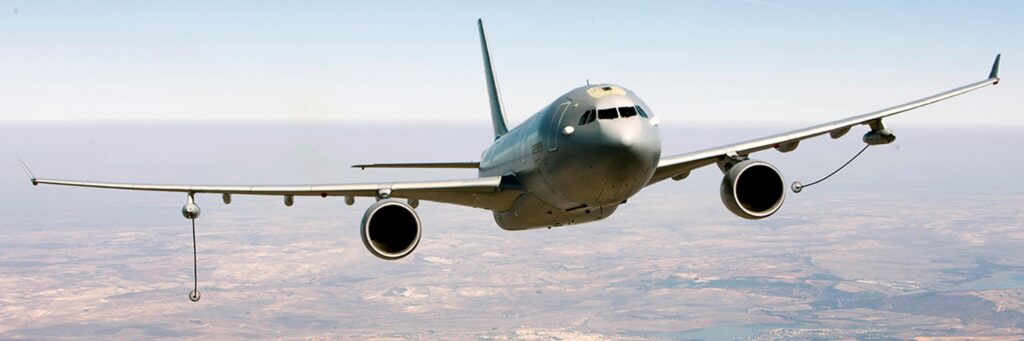
The first phase of the project focuses on the technological compromise required for future automation of operations, e.g., the degree of automation or support that needs to be introduced for manned and/or unmanned platforms.
The technologies will be evaluated, prototyped, and tested in real-world scenarios such as flight tests. This will enable the proper identification and tracking of the hose and drug delivery system and the receiving aircraft. Technical gaps to be addressed include sensors, computing power, and suitability for all weather conditions.
In addition, a simulation environment will be developed to determine the optimal trajectory of the receiving aircraft to the drop hose and to analyze the interaction between the two. Technology gaps have already been identified in terms of the required data/communication link between the tanker aircraft and the receiving aircraft, and the impact of factors such as latency, integrity, or accuracy of data has been investigated.
As part of the current project plan, a concept for improving parachute stabilization is being developed, which will also be evaluated in a representative environment such as a wind tunnel.
Finally, the project will also align this technological development with operational requirements and explore new ways of conducting AAR operations to increase their efficiency and consider new scenarios for the future.
Background
The project began in December 2022 and is being carried out as part of the European Defense Agency’s CapTech Aerial Systems program.
Further information can be found here: https://eda.europa.eu/news-and-events/news/2022/12/21/eda-begins-research-into-automatic-air-to-air-refuelling